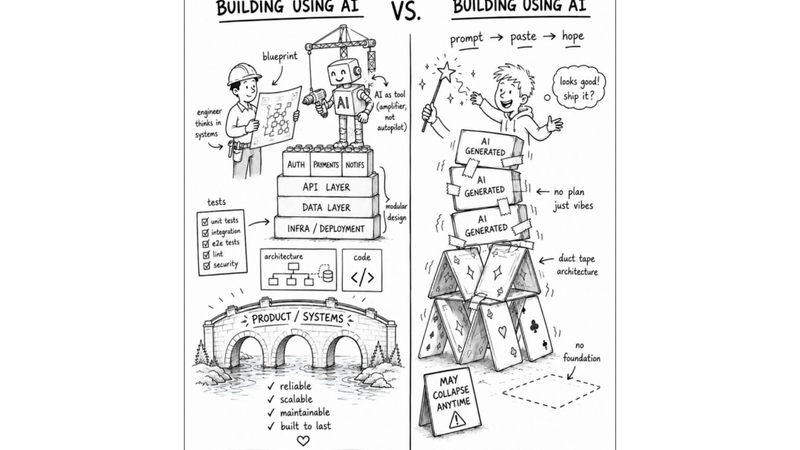
The 90% Illusion: Why Vibe Coding Needs an Engineering Reality Check

"Vibe coding"—the practice of building software by steering AI agents via plain-language intent rather than grinding out syntax—has completely transformed how we prototype. You describe a vision, a tool like Cursor, Windsurf, or Claude Code executes the edits, and suddenly you have a working UI.
It feels like magic. But it’s also an architectural illusion.
Vibe coding takes you 90% of the way. The problem is that the remaining 10% requires 90% of the actual systems engineering. While your AI-generated project looks and feels flawless on the surface, moving it from a "vibe" to a resilient, production-grade application exposes a massive structural gap.
The Mirage of the Serverless "Publish" Button
Modern terminal-first AI agents make deployment feel trivial. With a single natural language command, the agent can use local tooling to push a project to a serverless, internet-accessible URL. Your team or users can open it instantly. It looks like a finished product.
But what happens when you look under the hood?
Volatile State: In basic vibe-coded prototypes, data is often stored in local storage, mock JSON arrays, or ephemeral client-side memory.
Exposed Logic: Backend logic is frequently bundled into client-side code, creating massive security vulnerabilities, or it relies on isolated, stateless functions completely disconnected from a central source of truth.
A serverless frontend link is not a deployment strategy. It’s an online interactive sketch.
The Infrastructure Gap: Databases and Complex Integrations
To be fair, AI tooling has evolved. Modern agents utilize advanced frameworks like the Model Context Protocol (MCP) to securely bridge the gap between the LLM and your environment. An AI can now inspect live database schemas, run local build tools, and execute migrations.
However, looking at a database is not the same as architecting one. When forced to move beyond isolated code generation, pure vibe coding hits a wall:
1. The Database Dilemma
True applications require robust, relational, or non-relational data warehouses (like PostgreSQL, MySQL, or Snowflake) that handle concurrent states, strict security policies, and heavy read/write volumes. While an AI can execute basic CRUD commands, it cannot independently foresee:
Designing optimized indexing structures for high-velocity queries.
Managing complex schema migrations without risking data loss.
Preventing connection pool exhaustion when serverless functions scale rapidly under heavy loads.
2. The Opaque Integration Loop
AI agents thrive when integrating with pristine, heavily documented public APIs. But enterprise reality involves messy, legacy, or poorly documented third-party platforms.
When an integration requires highly nuanced token exchanges, strict webhook cryptographic verifications, or custom cURL configurations, the AI's context window becomes a limitation. Without exact public documentation to rely on, the agent begins to guess at parameters—trapping your project in an infinite loop of breaking changes.
The Reality Check: An AI agent can efficiently write code within an architecture, but it cannot independently decide how that architecture should scale, failover, or protect sensitive data.
How to Get the Best Results: Shift from "Prompting" to "Architecting"
Vibe coding is an incredibly powerful force multiplier if you treat it as leverage rather than a total replacement for engineering discipline. To get the absolute best results out of AI-driven workflows, you have to transition from a casual prompter to an active systems architect.
1. Establish the Structural Guardrails First
Don’t just type "add a database connection" and hope the AI guesses the right parameters. Define the environment boundaries beforehand. Spin up your own dockerized environments or cloud instances, map out the data models, and give the AI a rigid schema framework to work inside.
2. Practice Spec-Driven & Test-First Development
Before letting an agent generate integration code, have it write the integration tests first. Establish the exact data contracts, validation rules, and error-handling expectations. Once the guardrails are coded into the test suite, let the AI loop until the implementation passes.
3. Maximize Context Engineering
The secret to breaking past the 90% barrier is giving the model high-fidelity context. Use structured rules files (like .cursorrules), explicit system prompts, and live schema definitions via MCP servers. When the AI is anchored by real-world system constraints, its rate of hallucination drops precipitously.
The Verdict
Vibe coding has democratized prototyping and completely eliminated the friction of boilerplate development. But until a project incorporates dedicated data persistence, hardened server logic, and secure, verified integrations, it is a brilliant proof of concept—not a product.
The most successful developers and leaders won't be the ones who just "vibe." They will be the ones who use the vibe to build the vision, and rigorous engineering principles to secure the foundation.